
Reviewed · GUATEMALA CITY TOURS
Combo Tour: Colonial Antigua & Guatemala City Explorer Tour
Antigua and Guatemala City make an excellent pair because they show two very different sides of Guatemala in one long day. You begin among yellow colonial churches, ruined convents, and volcano views, then return to the capital for grand avenues, civic buildings, old monuments, and a busy handicraft market.
I like the contrast between the two places, and I like the small-group format, limited to 10 people. Guides such as Juan Pablo have earned strong praise for explaining Guatemala’s past clearly and keeping the day interesting. The main drawback is practical: several recent bookings had pickup or confirmation problems, so you should confirm the meeting details with Gray Line Guatemala before tour day.
Key points at a glance
- Antigua’s essential sights: See La Merced Church, Santa Catalina Arch, Central Park, and La Unión tank on foot.
- A volcano view: Antigua offers views toward Agua Volcano, especially from open parts of the city.
- Two cities in one day: Compare the former Spanish capital with modern Guatemala City.
- A compact group: The tour is limited to 10 participants, with English and Spanish guiding.
- A long but useful day: The 10-hour schedule covers a lot, though lunch is not included.
- A booking detail to watch: At least two adults are required, and pickup confirmation deserves extra care.
Why this combination works
If you have only one full day for sightseeing from Guatemala City, this tour gives you a strong first look at the country’s built history. Antigua delivers the romantic part of the day: cobbled streets, painted facades, church ruins, and stories tied to the colonial era. Guatemala City supplies the counterpoint, with broad avenues, government buildings, modern urban planning, and a historic center that still serves as the capital’s civic heart.
The price is $65 per person, including hotel transfers from most Guatemala City hotels and a bilingual guide. That is fair value for a 10-hour outing, especially since reaching Antigua and arranging transport back to the capital can take planning on your own. The tradeoff is that the day is more of an overview than a slow, museum-focused visit. You will see many places, but you will not have long, independent time at each one.
The tour is best for someone who wants orientation, context, and a well-packed route. If you prefer to linger over coffee in Antigua, shop at a relaxed pace, or study one church in detail, you may find the schedule too brisk.
More guatemala city tours in Guatemala City:
- PRIVATE SHUTTLE From Airport/Guate City to ANTIGUA or Vice-versa
★ 5.0 · 120 reviews - Shared shuttle – between Antigua and Guatemala City Airport
★ 4.5 · 103 reviews - From Guatemala City or Antigua: Pacaya Volcano Day Tour
★ 4.6 · 89 reviews
Starting in Antigua with La Merced Church
The day begins with pickup at your Guatemala City hotel, followed by the transfer to Antigua Guatemala. Once there, you meet the local guide and begin a walking tour of about three hours.
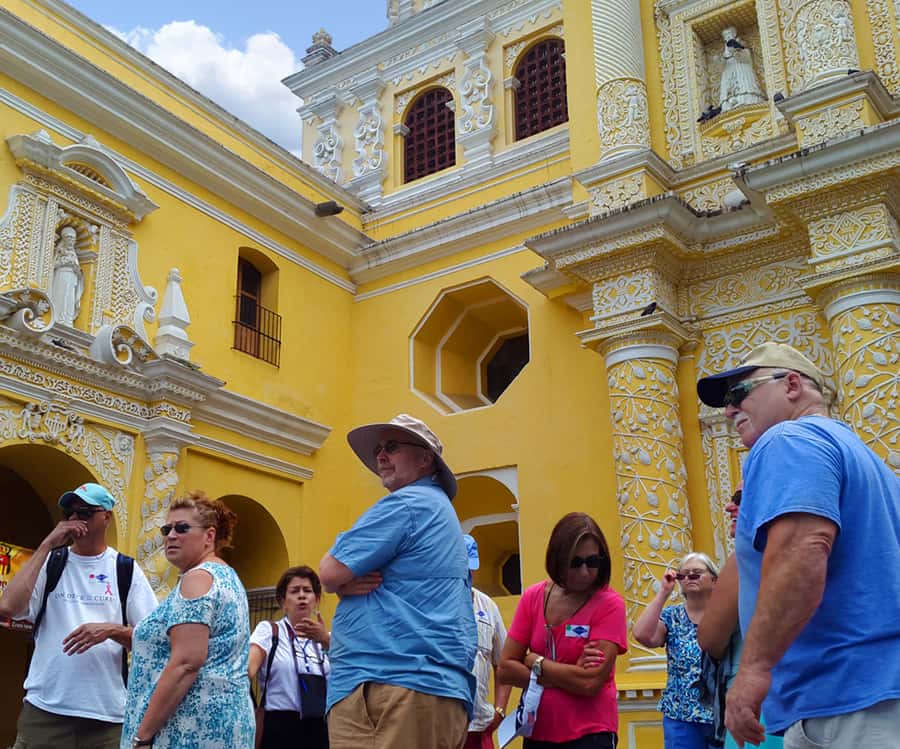
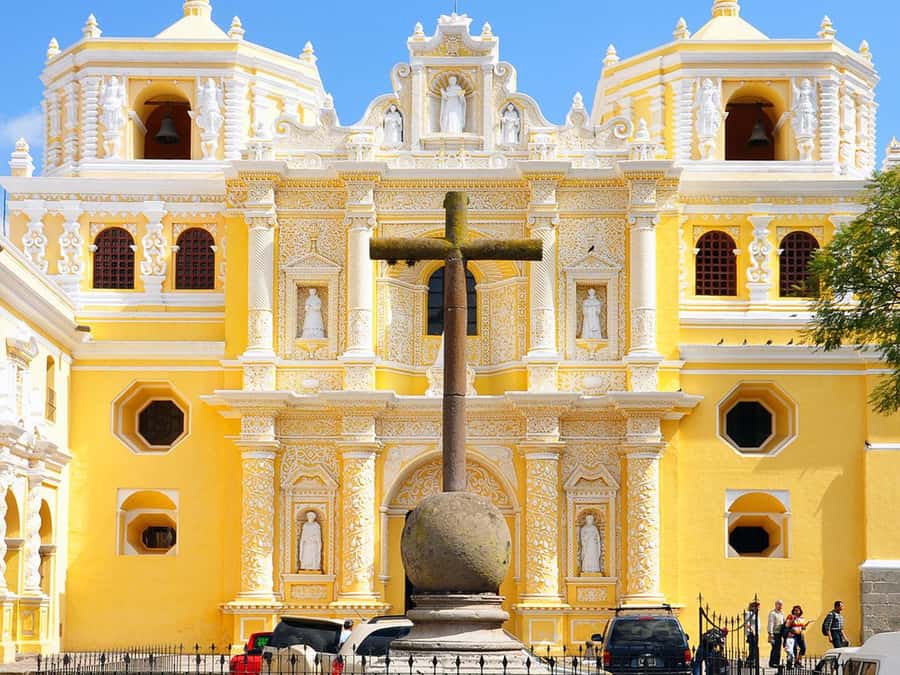
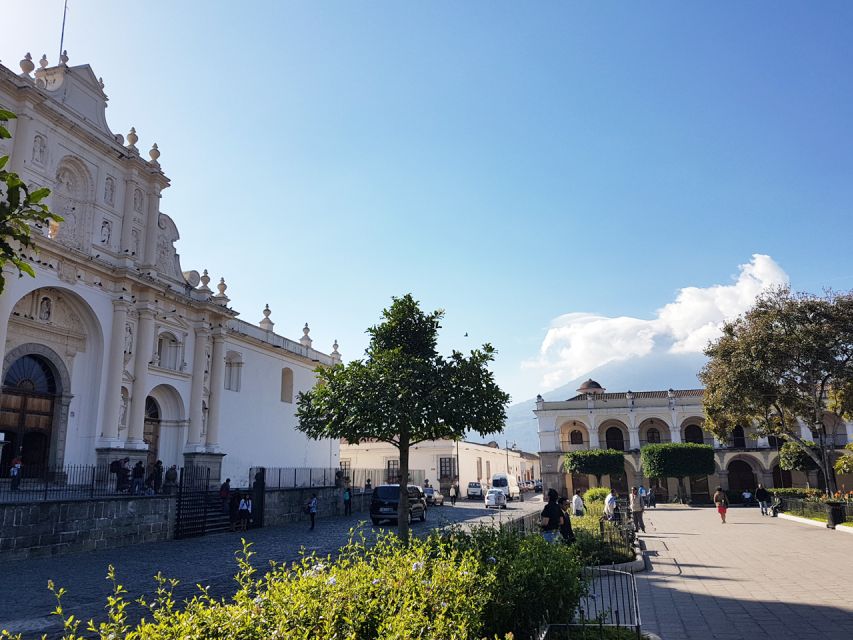
La Merced Church is an ideal opening stop. Its facade is a fine example of Guatemalan ultrabaroque design, with elaborate decoration that rewards a close look. Two bell towers frame the church, while a sculpture of San Pedro Nolasco appears high on the facade. He founded the Mercedarian Order, giving the building a direct link to the religious institutions that shaped colonial Antigua.
Your guide can help you read the facade instead of simply taking a photograph and moving on. Look for the way the decoration fills the surface, a style made for visual impact in a city where churches were both places of worship and public statements of power.
This is a walking tour, not a bus tour with brief photo stops. Wear shoes that can handle uneven streets, and expect several hours on your feet. A hat, sunglasses, and a camera are also sensible choices.
Santa Catalina Arch and Antigua’s earthquake story
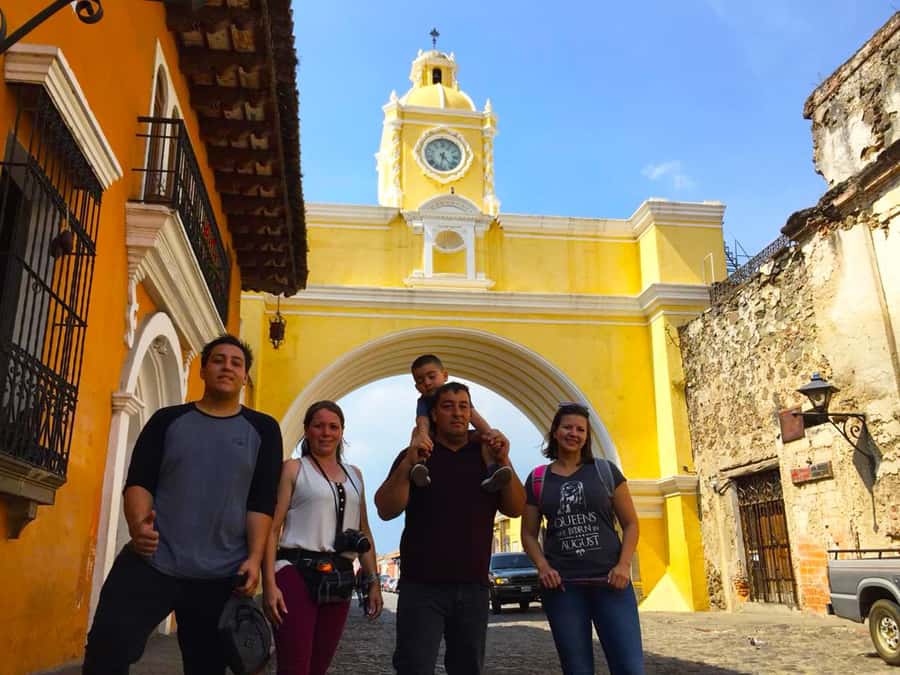
Santa Catalina Arch is one of Antigua’s most recognizable sights. It was built to let nuns move between religious cloisters without being seen in public, a small architectural detail that reveals how strictly daily life was organized for members of the order.
The arch took on new importance after the earthquakes of 1773. Changes included a turret and a Lamy Amp Lacroix clock made in France. The clock gives the structure a distinctive finish, while the arch itself has become a visual shorthand for Antigua.
The stop is brief but worthwhile because it connects architecture with custom. You are not just looking at a pretty arch. You are seeing a practical solution shaped by religious rules, later altered by earthquake damage and urban change.
Because this is one of Antigua’s best-known landmarks, it can be a busy place. The small-group arrangement helps your guide keep everyone together, but do not expect a private photograph with the street completely empty.
Central Park and the story of Las Sirenas
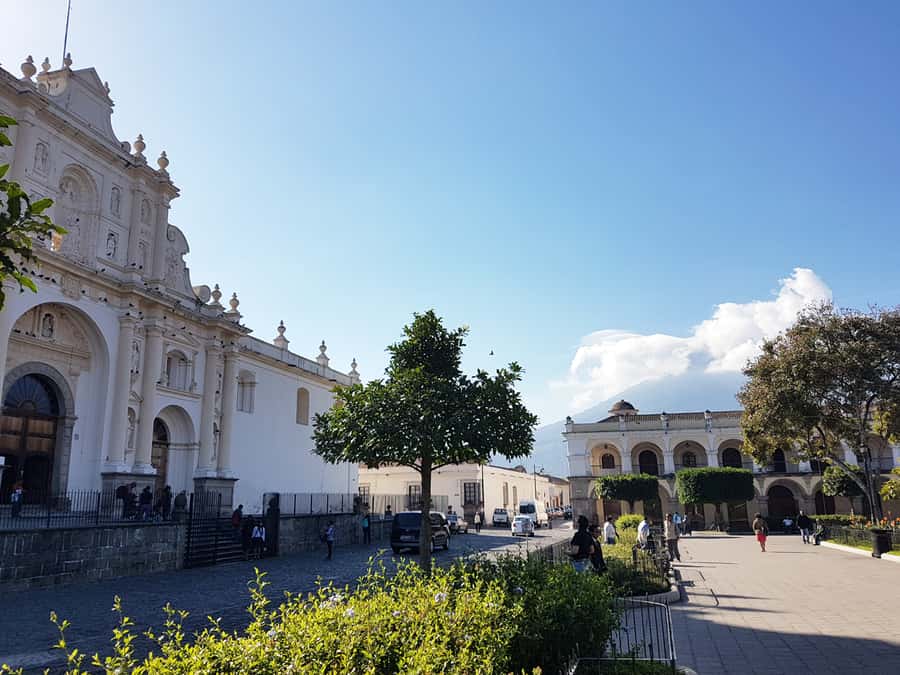
Antigua’s Central Park follows the traditional grid used in Spanish colonial towns. The square is surrounded by several of the city’s major buildings: the Palace of the General Captains, the Town Hall, San José Cathedral, and the Trade Portal.
This is the point where Antigua’s planning becomes easiest to understand. The plaza is not an isolated garden. It is the center of political, religious, and commercial life, with the most important buildings facing one shared public space.
In the park, you will also see the Las Sirenas fountain. Its folk story is grim. The Count of La Gomera ordered it built in memory of his daughters, who refused to nurse their children after giving birth. According to the tale, he had them tied to a trunk in the middle of a waterhole, where they died from hunger and thirst.
The fountain gives the guide a chance to explain how local stories mix morality, family power, and public art. It is also a reminder that historic places are not only made of dates and famous buildings. Their legends can be strange, harsh, and difficult to separate from fact. Listen for that distinction as the story is told.
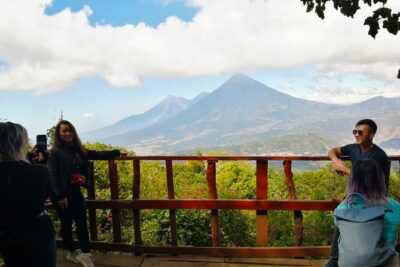
From Antigua, you may also appreciate views toward Agua Volcano. The volcano is one of the city’s most memorable visual features, and open streets and plazas can offer a good look depending on weather and visibility.
A few more Guatemala City trips to weigh up
- Lake Atitlán Sightseeing Cruise with Transport from Guatemala City
★ 4.5 · 87 reviews - Antigua Guatemala Full-Day Shared City Tour
★ 5.0 · 84 reviews - Half-Day Guatemala City Tour
★ 5.0 · 82 reviews - Lake Atitlan Day Tour from Antigua or the City | Boat & Villages
★ 4.5 · 76 reviews
La Unión tank and time for lunch
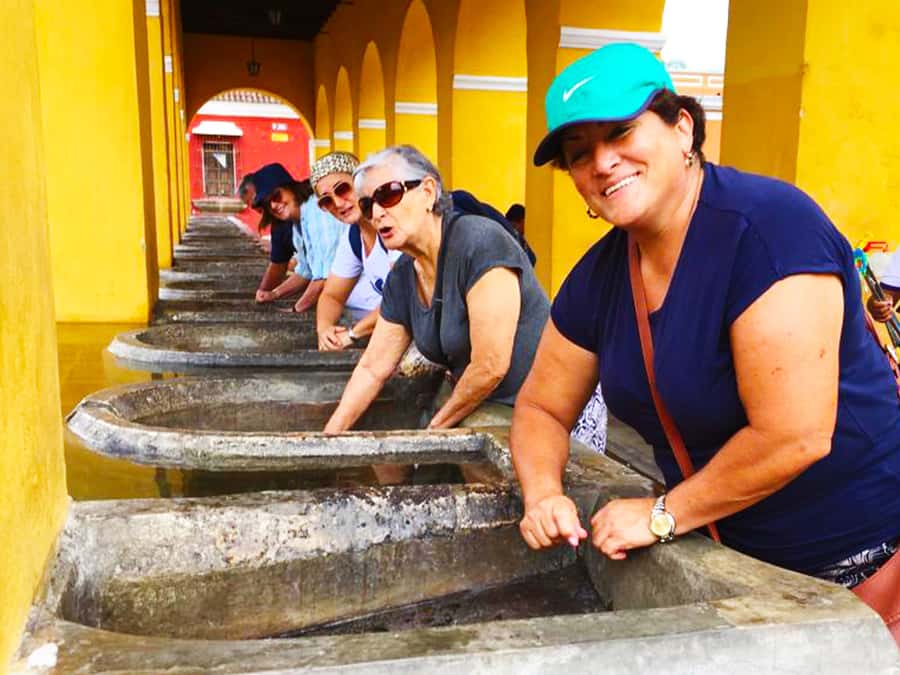
The walking route continues to La Unión tank, one of Antigua’s most notable public laundries. It opened on February 3, 1853, and offers a plain but revealing look at everyday life.
Large houses had their own washing facilities, but most residents used public laundries. That makes La Unión tank more than a picturesque old structure. It shows how city services and social class shaped ordinary chores. A visit here adds balance to the grand churches and government buildings because it focuses on domestic life.
After the Antigua walk, you receive time for lunch. Food and drinks are not included, so plan to pay separately. The supplied details do not name a particular restaurant or set menu, which gives the stop some flexibility but also means you should not expect a prepaid meal.
Keep lunch efficient. The second half of the day is in Guatemala City, and the full program lasts about 10 hours. A long restaurant stop could make the afternoon feel rushed.
Returning to the capital by way of Las Americas Avenue
After lunch, you transfer to Guatemala City for a city sightseeing route. The first stop is Las Americas Avenue, where a central garden contains plazas and monuments honoring countries across the American continent.
This avenue helps you see the capital as a planned modern city rather than only an old colonial center. Its monuments turn a major road into a civic display, with public space used to express regional connections and national identity.
The stop is more about the broad design of the avenue and its monuments than about entering a single landmark. It provides a useful change of pace after Antigua’s close streets and old churches.
Berlin Plaza and pieces of the Berlin Wall
Berlin Plaza contains three original sections of the Berlin Wall brought from Germany. From the plaza, you can also view part of Guatemala City and the volcanoes.
The wall fragments give the tour a surprising international note. After spending the morning with Spanish colonial architecture, you encounter physical pieces of 20th-century European history in Guatemala’s capital. The setting also gives you a chance to step back and take in the city and surrounding volcanoes.
This is a good stop for photographs, but its value goes beyond the concrete itself. The pieces invite questions about why a Guatemalan city displays part of a divided European city and how public monuments collect meaning far from their original setting.
La Reforma and its European influence
La Reforma was inspired by the grand avenues of France. Its statues, carved in stone, bronze, and marble, were brought from Italy, giving the route a distinctly European design language.
This part of Guatemala City shows how political and cultural leaders looked abroad for models of urban style. Wide avenues and formal monuments were intended to make the capital feel modern and internationally connected.
The contrast with Antigua is especially clear here. Antigua’s spaces developed around colonial religious and administrative institutions, while La Reforma reflects a later taste for boulevards, sculpture, and ordered civic design.
Yurrita Church, a personal votive offering
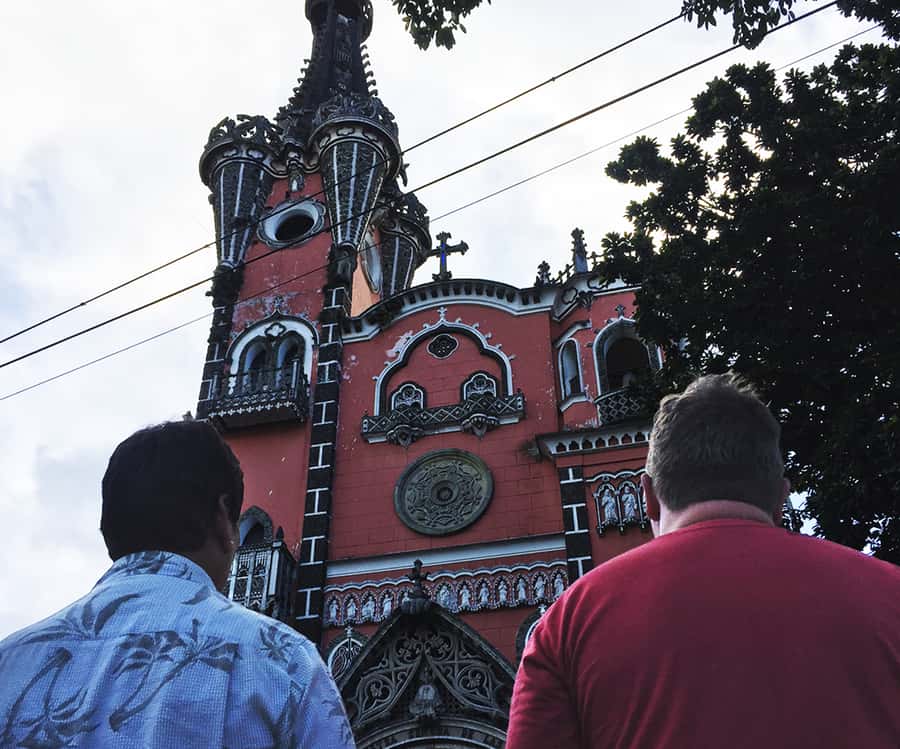
Yurrita Church is a private chapel with a mixed Baroque style and Romanesque and Byzantine elements. It was built by Felipe Yurrita, a native of Arévalo in Castile, Spain, as a votive offering to Our Lady of Sorrows, the patron of his hometown.
The chapel was connected to a personal rescue story involving the eruption of Santa María Volcano. Its design is unusual because it does not fit neatly into one architectural category. The mixture of styles makes it a useful stop for understanding how personal devotion can produce buildings that do not follow the dominant local pattern.
You should listen closely here, since the significance lies in the connection between the building, its donor, the Virgin, and the volcanic event. This is one of the more distinctive stops in the capital route.
The Civic Center’s mid-century architecture
At Guatemala City’s Civic Center, you see a group of buildings constructed during the 1950s and 1960s. The group includes the Supreme Court of Justice, Ministry of Public Finance, City Hall, Social Security, Bank of Guatemala, National Mortgage Bank, and the Guatemalan Tourism Commission.
The Civic Center adds a modern architectural chapter to the day. Rather than focusing on colonial facades, the tour shows how Guatemala represented government, finance, law, and public administration in the middle of the 20th century.
This is a useful stop for anyone interested in cities as living places. Guatemala City is not simply an older town surrounded by newer buildings. It has its own civic identity, shaped by institutions and modern construction.
Constitution Plaza and the historic center
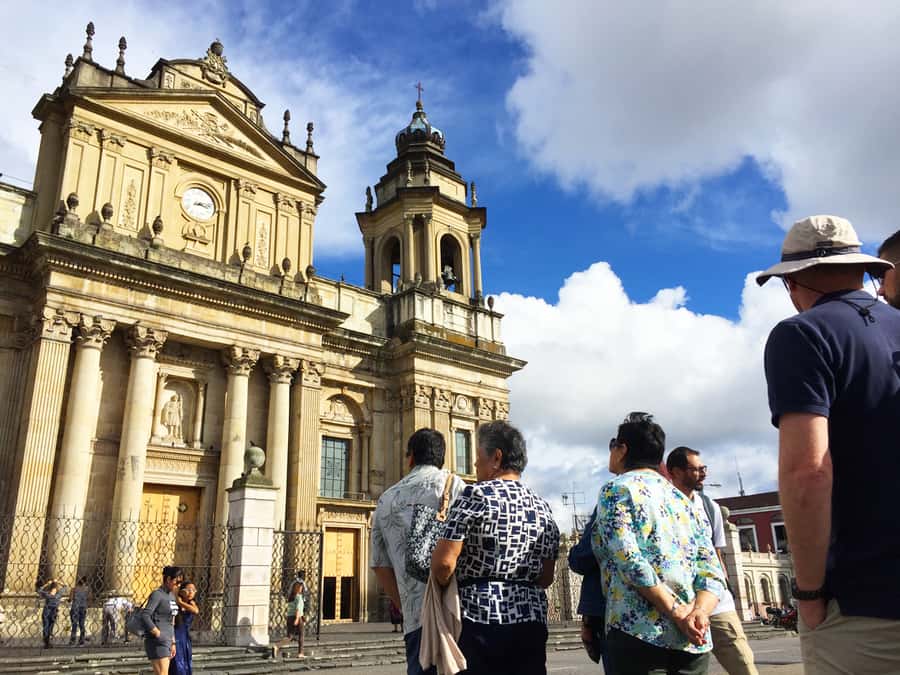
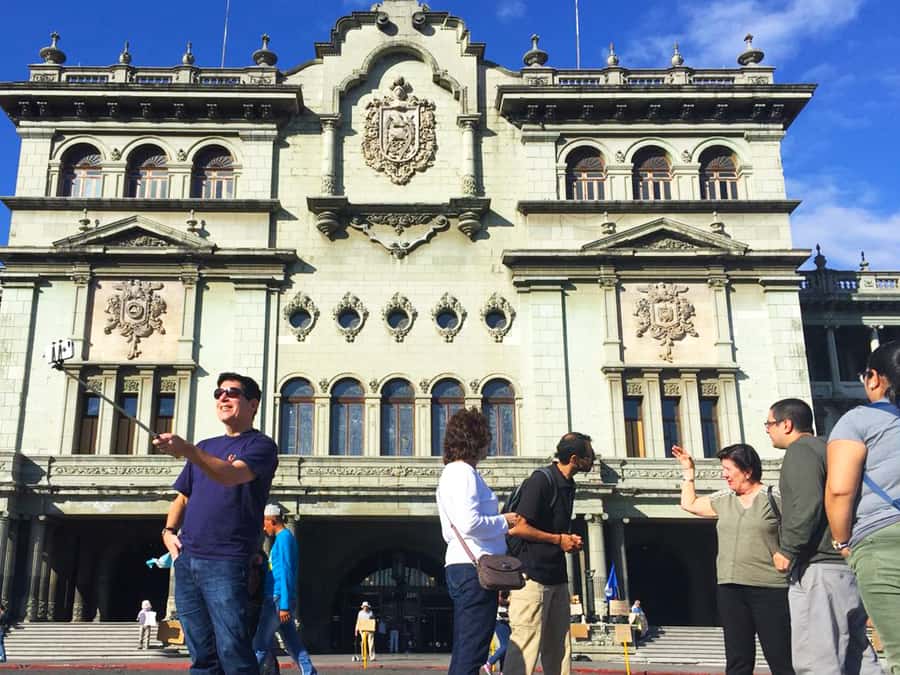
The final major section of the tour brings you to the Plaza of the Constitution, the heart of Guatemala City’s historic center. The National Palace, Metropolitan Cathedral, Portal of Commerce, and Centenarian Park surround the plaza.
The square gives you a clear sense of the capital’s formal center. Government, religion, commerce, and public celebration all meet here. If Antigua presents colonial planning on a smaller scale, Constitution Plaza shows how those traditions continue in the capital.
You then visit Central Market, located behind the Metropolitan Cathedral in the basement of Tabernacle Plaza. It is a practical place to see crafts from across Guatemala, including ceramics, textiles, leather, wood, and silver.
This is the best stop for buying a small reminder of the country, though you should remember that shopping is optional and purchases are not included. The market also provides a more everyday setting after the grand plazas and official buildings. Allow your guide to explain what you are seeing, then take time to look carefully at the range of materials and regional styles.
At the end of the walking portion, you return to your hotel in Guatemala City.
What the $65 price really covers
At $65, the tour offers a lot of ground for the money. You receive round-trip hotel transfers from most Guatemala City hotels, a bilingual English and Spanish guide, transportation between the two cities, and a full 10-hour schedule.
The strongest value is the guide-led context. Antigua’s churches, fountains, arches, and public spaces can be admired without help, but the stories about the Mercedarian Order, the nuns’ passageway, Las Sirenas, and La Unión tank make the stops more meaningful. In Guatemala City, the guide helps connect monuments that might otherwise feel scattered.
The price does not include lunch or drinks. You should also factor in the physical cost of the day: a transfer, around three hours of walking in Antigua, more sightseeing in the capital, and a return to your hotel. This is good value for an active first-day survey, not a relaxed excursion.
Group size, guide quality, and booking caution
The group is capped at 10 participants, which is a useful middle ground. You get more personal attention than on a large coach tour, while the price stays below that of a private outing.
The guide can make or break a history-heavy day. Juan Pablo received particularly strong praise for explaining Guatemala clearly and keeping the tour engaging. Other positive feedback also focused on guides who gave clear information, showed care for comfort, and pointed out relevant historical details.
There is one important caution. Several bookings resulted in missed pickups, cancellations without clear notice, or no confirmation and no response. The overall rating is 3.9 from 24 reviews, which reflects both very strong guide experiences and serious service failures. I would contact the local supplier before the day of departure to confirm the pickup time, hotel location, and operating status.
The tour needs at least two adult passengers to run. If that minimum is not reached, the tour may be canceled, with tickets refunded or rescheduled. French, German, and Italian guides may be available for an added cost, subject to availability.
Who should book this day
I would choose this tour if you are staying in Guatemala City and want a broad introduction to two important places without arranging several separate transfers. It suits first-time visitors, history fans, architecture fans, and anyone who prefers a guide to explain what they are seeing.
It is less suitable for people with mobility impairments, since the Antigua portion involves about three hours of walking and the day continues with sightseeing in the capital. Comfortable walking shoes are essential.
You should also skip it if you want a slow Antigua visit with long cafe breaks, extended shopping, or time inside many individual buildings. The strength here is range. You see the big picture, then decide which city deserves a longer return visit.
Should you book the Colonial Antigua and Guatemala City Explorer Tour?
Book it for the two-city contrast, strong historical storytelling, and useful transportation package. At $65, the itinerary gives you a solid amount of sightseeing, and a good guide can turn a long list of monuments into a connected story about Guatemala.
Before paying, confirm that Gray Line Guatemala has your hotel and pickup details, since several reported service problems involve communication and transport. If that concern is settled, and you are comfortable with a full day on foot, this is a practical way to meet Antigua and Guatemala City in one sweep.
FAQ
How long does the tour last?
The tour lasts about 10 hours, including the transfer from Guatemala City to Antigua, sightseeing in both cities, and the return to your Guatemala City hotel.
Where does the tour begin?
Pickup is provided at your hotel in Guatemala City from most hotels. You then transfer to Antigua Guatemala to meet the local guide.
How much does the tour cost?
The listed price is $65 per person.
What languages are available?
The tour includes a bilingual English and Spanish guide. French, German, and Italian guides may be available for an additional cost, depending on guide availability.
How large is the group?
The activity is offered as a small group limited to 10 participants.
Is lunch included?
No. Lunch, food, and beverages are not included. You receive time for lunch during the Antigua portion and pay for your meal separately.
What places do you visit in Antigua?
The Antigua walk includes La Merced Church, Santa Catalina Arch, Central Park, the Las Sirenas fountain, and La Unión tank. You can also appreciate views toward Agua Volcano when conditions allow.
What places do you visit in Guatemala City?
The route includes Las Americas Avenue, Berlin Plaza, La Reforma, Yurrita Church, the Civic Center, Constitution Plaza, and Central Market.
What should you bring?
Bring comfortable walking shoes. A hat, sunglasses, and camera are also recommended.
Can people with mobility impairments join?
The tour is not considered suitable for people with mobility impairments because it includes an extended walking tour and sightseeing across two cities.
Just added around Guatemala City
- Guatemala City Highlights Shared Tour★ 4.6 · 14 reviews
- Iximché: Archaeological Site from Guatemala City★ 4.8 · 4 reviews
- Hobbitenango and Antigua Tour: From Guatemala City★ 4.2 · 10 reviews
- From Guatemala City Hobbitenango Day Tour★ 4.5 · 12 reviews
- From Guatemala City Chichicastenango in 1 day.★ 3.3 · 8 reviews
- From Guatemala City, Tour to Antigua Guatemala★ 4.5 · 3 reviews
- Antigua Guatemala , Full-Day Shared Tour from Guatemala City★ 4.8 · 9 reviews
- From Guatemala City to Semuc Champey in one day.★ 4.7 · 8 reviews
Guatemala City Tours, compared.
From Guatemala City or Antigua: Pacaya Volcano Day Tour
Read our review →
Lake Atitlán Sightseeing Cruise with Transport from Guatemala City
Read our review →

Lake Atitlan Day Tour from Antigua or the City | Boat & Villages
Read our review →
Pacaya Volcano Tour and Hot Springs from Guatemala City
Read our review →Browse the lists this tour appears in